
Autry State Prison Releases
Autry is a Georgia Department of Corrections state prison, not a Mitchell County jail. A person leaving Autry may transfer to another GDC facility, discharge at sentence completion, enter parole, or be delivered to another authority under a detainer. GDC records the state-custody event. The parole board and Department of Community Supervision supply the parole and supervision context.
Do not call the Mitchell County Justice Center to confirm an Autry discharge unless a separate county hold is documented. A state-prison departure belongs in the statewide offender record. The Mitchell County released inmate search explains why release from one agency may continue as custody elsewhere.
Confirm Autry Release Status
Use GDC Find an Offender. Search by name, GDC ID, case number, age, or other identifiers and compare all available details. GDC may show custody status, current or prior facility, sentence fields, maximum release date, and a photo when available.
- Match the GDC ID before relying on a common name.
- Read the status and facility history together.
- Distinguish transfer, discharge, parole release, and release to a detainer.
- Use the TPM lookup only for tentative parole timing.
- Use the parolee search and DCS to verify supervision after release.
A tentative parole month is not a guaranteed release date. The board may grant, deny, defer, advance, postpone, or withdraw parole before it takes effect. Residence-plan review, discipline, detainers, and sentence changes can affect timing.
Autry Records and Contact
Facility staff can answer operational questions, while GDC Inmate Records and Information is the formal state-record route. Give the GDC ID, full name, and date range. Ask for existing custody, release, or discharge records.
Autry State Prison3178 Mount Zion Church Road
Pelham, GA 31779
Mail: P.O. Box 648, Pelham, GA 31779
Phone: (229) 294-2940
Fax: (229) 294-6559
GDC lists Inmate Records and Information at P.O. Box 1529, Forsyth, GA 31029. Its general contact address is 300 Patrol Road, Forsyth, and the inmate questions number is (404) 656-4661. A court judgment supplies the legal sentence, but GDC and the parole board maintain the operational release calculation.
Autry State Prison Profile
GDC describes Autry as a medium-security facility for adult male felons with capacity for 1,698. Its housing includes general population, Level II mental-health beds, an In-House Transitional Unit, and an Accommodated Living Unit. These are state-prison functions and should not be confused with pretrial county jail custody.
Capacity and housing type identify the institution. They do not establish a specific person's location or release. Always match the live GDC record.
Autry History in Pelham
The GDC Autry location page says the prison was constructed and opened in 1992, then renovated in 1998. Those dates distinguish it from the county correctional institution near Camilla, which opened decades earlier.
The source capture below records GDC's facility facts and contact information.
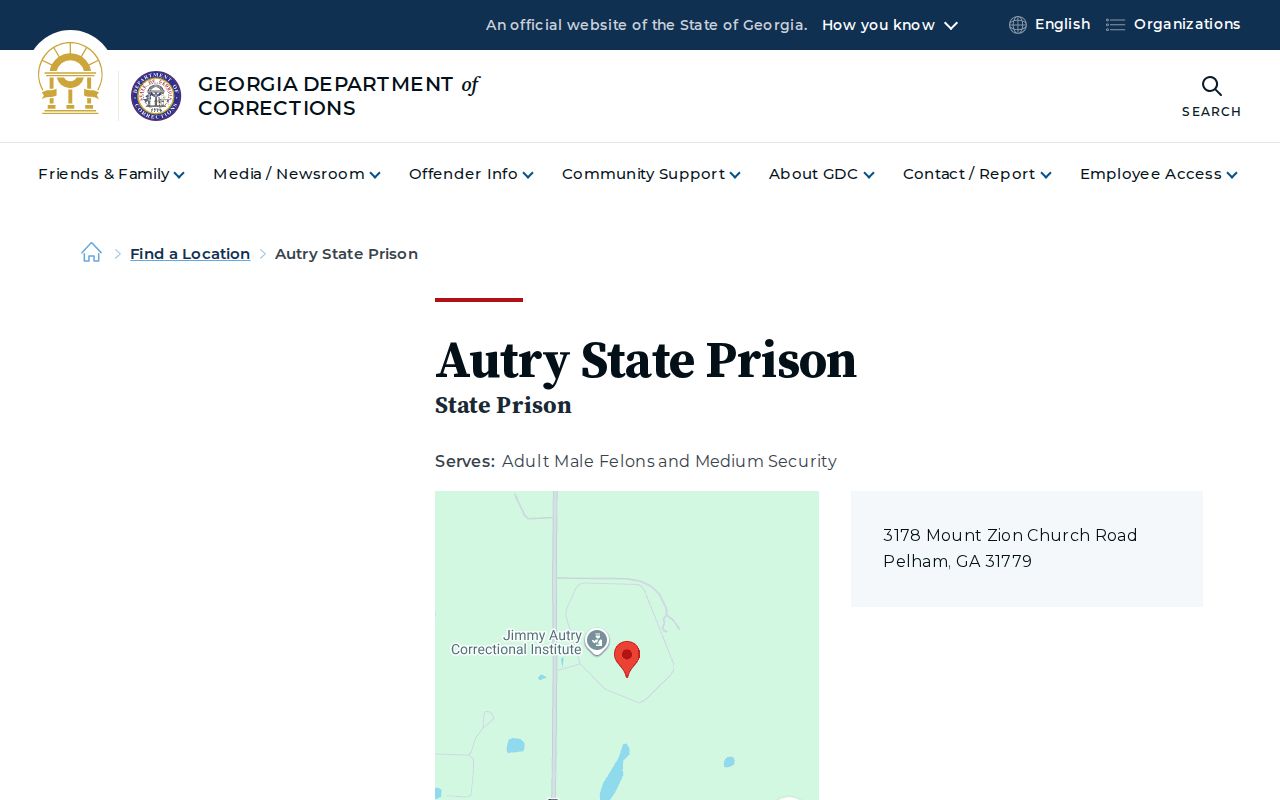
Facility history is useful for identifying the correct institution. It does not determine a sentence or parole result.
Autry Programs and PIC
GDC lists academic, counseling, faith and character, recreation, religious, vocational, and on-the-job training options. Work details include Autry grounds and maintenance, the Correctional Industries Boot Plant, and a ten-person fire station. These details can relate to a case plan and reentry preparation.
Georgia's Performance Incentive Credit program may let eligible offenders earn points through approved case-plan goals, education or vocational progress, and qualifying work assignments. The parole board decides whether PIC advances a tentative parole month, and GDC applies eligible credit to a maximum release date. A program listing is not proof that one prisoner earned or received credit.
Autry Parole and Discharge
Most parole-eligible Georgia inmates become statutorily eligible after one-third of a sentence, but serious violent felony, recidivist, life-sentence, offense-date, and non-parole categories differ. There is no safe universal percentage. The Georgia parole process is the source for general eligibility, while the TPM lookup supplies person-specific tentative timing.
Parole release means the person leaves prison under conditions. Discharge can mean the sentence or state custody obligation ended. Transfer means custody continued at another location. Release to a detainer means another authority received the person. These outcomes must not be collapsed into one "out" status.
- TPM
- A tentative parole month, subject to final review.
- Detainer
- A hold or request from another authority.
- Discharge
- An end to the relevant custody or sentence status shown by GDC.
Autry Visitation Is Separate
GDC lists visitation on Saturdays, Sundays, and state holidays from 9:00 a.m. to 3:00 p.m. Visitation rules and approval do not establish release timing. Call the prison for current operational instructions and use GDC records for offender status.
Families should not plan a pickup around a TPM or court rumor. Confirm the final GDC status and ask about the release destination. If parole begins, verify the parole office and start date. If a detainer controls the departure, contact the receiving authority instead.
Autry Release Record Fields
A state inquiry should include name, GDC ID, case number, birth date, and known Autry dates. Ask for status, facility history, release or discharge date, release type, sentence data, and receiving authority. If parole applies, seek the parole begin and end dates and office through the proper tool.
A maximum release date is a calculation, while a TPM is tentative. A parole begin date marks supervision, not sentence end. Discharge differs from transfer. An agency handoff may end GDC location status while custody continues.
GDC warns public information can change. For an official record, contact Inmate Records. Save the query date and GDC ID to compare later changes.
Autry Court and Detainer Context
The sentencing court supplies the judgment. An amended sentence, credit, appeal, or order can change GDC calculation after the court acts. Obtain the court record when dates conflict, then ask GDC how the change was applied.
A detainer from another county, state, federal, military, or immigration authority can alter destination. Release to that authority is not community release. Follow the receiving agency named in the record.
Autry Status Corrections
If the GDC search conflicts with a court order or another official record, verify the GDC ID and send the supporting document to the office that owns the disputed field. GDC handles state offender and sentence calculations. The parole board handles its decisions and tentative parole data. DCS handles community supervision records. The sentencing clerk maintains the judgment.
A name-only search is not enough for a correction. Include the identifier, source page, query date, exact field, and document showing the expected value. Keep the request and reply. Public information may update after internal review, so compare the new status using the same GDC ID.
If Autry confirms the person departed but the public result has not changed, ask whether the event was a transfer, discharge, parole release, or handoff. That distinction identifies the correct next source and prevents a facility departure from being mistaken for unrestricted community release.