
Mitchell Release Date Meanings
Mitchell County has several records that people often call a release date. A pretrial detainee at the Justice Center usually has no fixed release date. Release may depend on bond, dismissal, a new court order, or case disposition. A sentenced county inmate can have a sentence-expiration calculation reduced by lawful earned time. A state prisoner at Autry State Prison or a state inmate at Mitchell County Correctional Institution may have a maximum release date in GDC records. A parole-eligible prisoner may also receive a Tentative Parole Month, or TPM.
Those dates are not interchangeable. VINE may report a scheduled or actual custody change when an agency supplies it, but VINE does not calculate a sentence. The court states the lawful sentence. The custodian applies valid credits, and the Parole Board controls parole decisions.
| Date | Meaning | Best source |
|---|---|---|
| County sentence estimate | Sentence end less lawful county earned time | County custodian and court record |
| Maximum release date | GDC sentence-computation date | GDC offender record or written verification |
| TPM | Month for final parole review | Georgia Parole Board lookup |
| Actual release | Recorded departure, discharge, or transfer event | Releasing or receiving agency |
Find Mitchell Projected Release Dates
Start with custody type. The three facilities in Mitchell County serve different roles. The Justice Center is the county jail. The correctional institution houses both state inmates and county offenders. Autry is a GDC state prison. A search in the wrong system can produce no result even when a valid record exists.
- Confirm the full name, date of birth, booking number, GDC ID, or case number available for the person.
- Ask whether the person is pretrial, a sentenced county inmate, a state inmate, or under parole review.
- For county custody, call the Justice Center or correctional institution and compare the answer with the sentencing court record.
- For state custody, use GDC Find an Offender and read the location, sentence, and release or discharge fields carefully.
- If parole applies, check the Board's TPM explanation and lookup route.
- Confirm any date that affects pickup, court action, or a receiving-agency transfer with the custodian.
GDC states that its public search is not guaranteed complete and directs written verification to Inmate Records and Information, P.O. Box 1529, Forsyth, GA 31029. A released state-prison result differs from a county jail release entry. The county record controls the local event; GDC controls the state-prison status.
For an actual custody-change alert rather than a sentence calculation, the Mitchell County VINELink Check explains person-specific registration and confirmation.
Mitchell County Earned Time
O.C.G.A. § 42-4-7 governs earned time for county inmates. It permits a sheriff, jailer, warden, or designated county custodian to award credit based on institutional behavior. In general, earned time cannot exceed one-half of confinement. The statute also permits an authorized work-detail credit of no more than four days for each day worked, with listed exclusions for some offenses. The county inmate is released at sentence expiration less earned time.
The related rule in O.C.G.A. § 42-4-4 bars a sheriff from releasing a prisoner before lawful sentence completion, including lawful credits, unless a law or court order authorizes release. Credits are therefore not a promise. The custodian must confirm what was awarded, lost, or excluded in the individual Mitchell County calculation.
A county sentence can also change through an amended order or corrected time-served credit. Court records show the legal sentence, while jail or institution records show the applied custody calculation.
Note: A person awaiting trial has no county earned-time release estimate until a sentence or other lawful release basis exists.
Two Mitchell Good-Time Systems
Mitchell County's most distinctive date issue is the mixed population at Mitchell County Correctional Institution. The county says it houses state inmates and a smaller number of county offenders. Two people in the same building can therefore have different release-date rules. A county offender follows county sentence and earned-time rules. A state inmate follows GDC computation, parole rules, and any eligible Performance Incentive Credit.
The GDC Performance Incentive Credit program, called PIC, may reduce an eligible state offender's TPM or maximum release date by one to twelve months. Points may relate to completion of a reentry case plan, educational or vocational improvement, and work or detail assignments. The Parole Board keeps final discretion, and poor conduct can delay consideration.
Review the official GDC PIC source shown below.
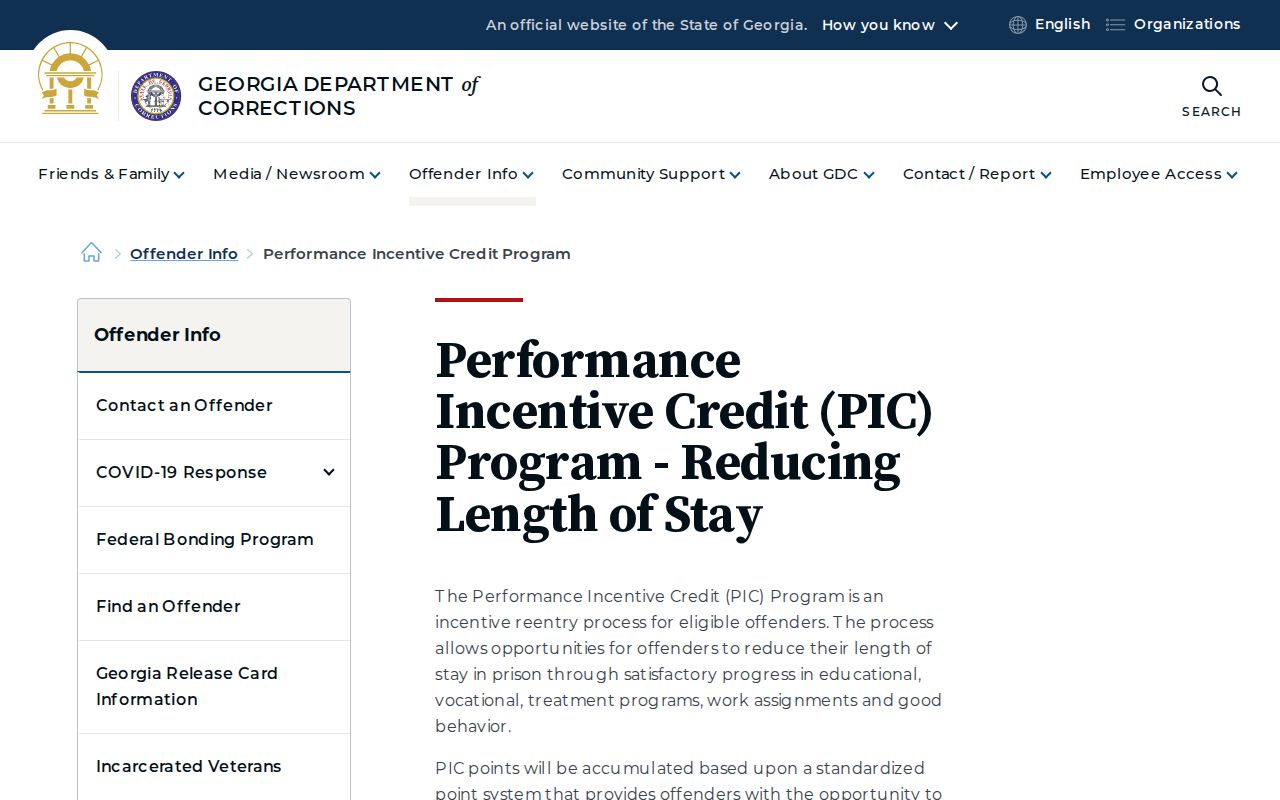
The captured GDC source supports the state credit path, which must not be applied to a county inmate merely because both are held in Mitchell County.
Mitchell Tentative Parole Months
A TPM is not a final release date. The Georgia State Board of Pardons and Paroles describes it as the month when final review is expected and, if appropriate, a parole date may be set. Good conduct and required program completion can remain conditions. Misconduct may postpone or cancel a TPM. The Board may also deny, defer, advance, delay, or withdraw parole before the effective date.
For most parole-eligible inmates, the Board's parole process describes eligibility after one-third of the prison sentence. Georgia has no universal “85 percent” rule for every prisoner. Serious violent felony provisions, recidivist status, offense date, life sentences, and non-parole-eligible categories can control instead. Only the actual sentence and Board rules can answer a person's case.
The Board's TPM source explains the distinction visible in this capture.
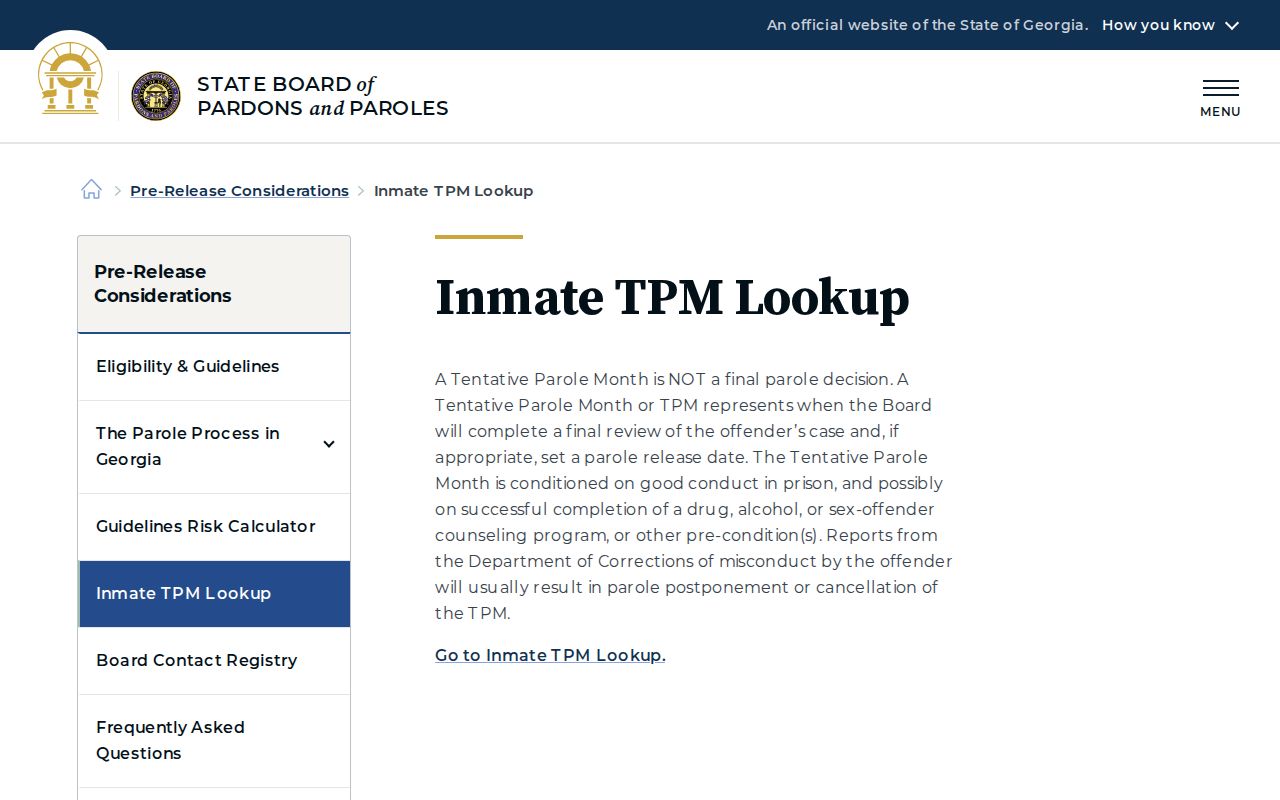
The TPM source is relevant to parole-eligible state inmates at Autry and the correctional institution, not to a person held pretrial at the Justice Center.
Changes to Mitchell Release Dates
A projected release date is a snapshot. Some changes shorten custody, while others delay departure or change the destination. The relevant office should explain which event was entered and when its record updated.
| Change | Possible effect | Confirm with |
|---|---|---|
| Amended sentence or time-served credit | Moves the lawful sentence calculation | Sentencing court and custodian |
| Bond posted or revoked | Creates or cancels a county release path | Jail and court |
| County earned time | May shorten a county sentence | County custodian |
| PIC or misconduct | May advance or delay a state date or TPM | GDC and Parole Board |
| Detainer or transfer | Changes the receiving authority, not always custody itself | Sending and receiving agencies |
| Residence plan | Unverified plans may delay parole | Parole Board and DCS |
| Court dismissal or order | Can create a new lawful release basis | Court and jail |
| Weekend processing | May affect entry and notice timing | Custodian |
A detainer is a request by another authority to hold or receive the person. “Released” to that detainer means the person left one custodian, not that the person entered the community. Federal, immigration, military, state, or another county authority may be next.
Confirm Mitchell Actual Release
The final check should match the source to the event. For the Justice Center, call (229) 336-2030 or request the release entry through the Sheriff's open-records contact. For a county offender at the correctional institution, contact the institution at (229) 336-2045 and compare the sentence file. For a state inmate, use GDC and the Board, then DCS if parole supervision begins.
VINE can provide a custody-change notice when the agency participates, but it may lag and is not a historical jail archive. A court docket can explain bond, dismissal, sentence, or amendment. No current-custody roster should be treated as proof of a past release. Once someone leaves a roster, the durable records are the release entry, sentence file, GDC record, and any parole decision.
The broad Mitchell County released-inmate search helps when the original custodian is not yet known. Use the narrowest official source once the custody path is clear.
Verify Mitchell Release Calculations
Written confirmation can matter when a portal shows only a partial date. For a county case, ask for the existing booking and release record plus the sentence or court-order notation. Give the full name, date of birth if known, booking date, and case number. For a GDC case, include the GDC ID and request sentence-computation or release verification from the state records office. Specific identifiers reduce the chance of matching the wrong person.
Record timing also matters. A jail may process a court order after the clerk enters it, and VINE may receive the event later. GDC and parole records follow their own update cycles. Note when each source was checked. If dates conflict, ask the custodian which one is current, what event changed it, and whether a detainer controls the next step.
A final entry should state what happened, not merely what was expected. A transfer calls for a check with the receiving authority. A community release may start parole, probation, or another court condition. This keeps a Mitchell County projected release date separate from actual release and the later end of supervision.