
Mitchell Parole and Probation
A released Mitchell County person may be on parole, probation, both in sequence, or neither. Parole is release from a Georgia prison sentence under conditions set by the Georgia State Board of Pardons and Paroles. Probation is a sentence ordered by a court that permits the person to live in the community under stated terms. The Georgia Department of Community Supervision, or DCS, handles felony probation and parole field supervision. Mitchell County Probation handles local misdemeanor probation. A person who bonded out of the Mitchell County Justice Center is not automatically on either one.
The source must match the case. State prisoners released from Autry State Prison, or state inmates housed at Mitchell County Correctional Institution, may appear in the state parole channels. A county offender can instead have a local misdemeanor order. Court records remain important because they show the sentence and any later change.
| Record type | How it begins | Mitchell County verification |
|---|---|---|
| Parole | Board-authorized release from a state prison sentence | Georgia parolee search, Board records, and DCS |
| Felony probation | Superior Court sentence or later court order | DCS field office and court file |
| Misdemeanor probation | Local court sentence | Mitchell County Probation and sentencing court |
| Discharge | Supervision term lawfully ends | End date, discharge record, and court or agency confirmation |
- Parole
- Conditional community release while a state prison sentence continues.
- Probation
- A court sentence served under rules in the community.
- Discharge
- The formal end of the sentence or supervision term.
- Absconder
- A supervised person reported as no longer complying with required contact or location rules.
- Detainer
- A request from another authority to hold or receive a person.
Verify Mitchell Post-Release Supervision
The public Georgia parolee search is the first check for a known state parole case. Research for Mitchell County shows that it can return parole begin and end dates, the parole office and phone number, and the primary offense. It does not replace the sentence record. Common names require care, and a missing result may mean the person is on probation, has discharged, or was never a parolee.
- Decide whether the person left the county jail, Autry State Prison, or the mixed-population correctional institution.
- For a state prisoner, check the GDC offender record, then search the parolee tool with the best known identifiers.
- Read the parole begin date, end date, office, and primary offense only after confirming the identity.
- For felony probation or parole field questions, use the DCS field office list and confirm the assigned office.
- For a misdemeanor sentence, contact Mitchell County Probation and check the sentencing court file.
- Ask the named agency or court to confirm a disputed status, discharge, violation, or transfer.
The GDC Find an Offender search helps establish whether the person was a state inmate and whether the record shows a current location or released status. The Mitchell County home search and release-record coverage gives the broader path when the custody source is uncertain. A live jail channel is for current custody, while parole and probation records concern community supervision after release.
Mitchell Probation Office Details
Mitchell County has a separate office for misdemeanor probation. That local division matters because the statewide parolee search can return no match even when a person is still bound by a county misdemeanor probation order. The Mitchell County Probation page identifies Director Claye McCook and states that the office supervises misdemeanor cases. Felony cases remain with DCS.
Mitchell County Probation
Director: Claye McCook
Address: 30 North Court Street
Camilla, GA 31730
Phone: (229) 336-2062
Hours: Monday through Friday, 8:00 a.m. to 5:00 p.m.
The official office page is shown in the captured source below. Its local role is narrower than the role of DCS, so callers should know whether the sentence is a misdemeanor or felony before asking for a Mitchell County supervision record.
View the county source for misdemeanor probation office details.
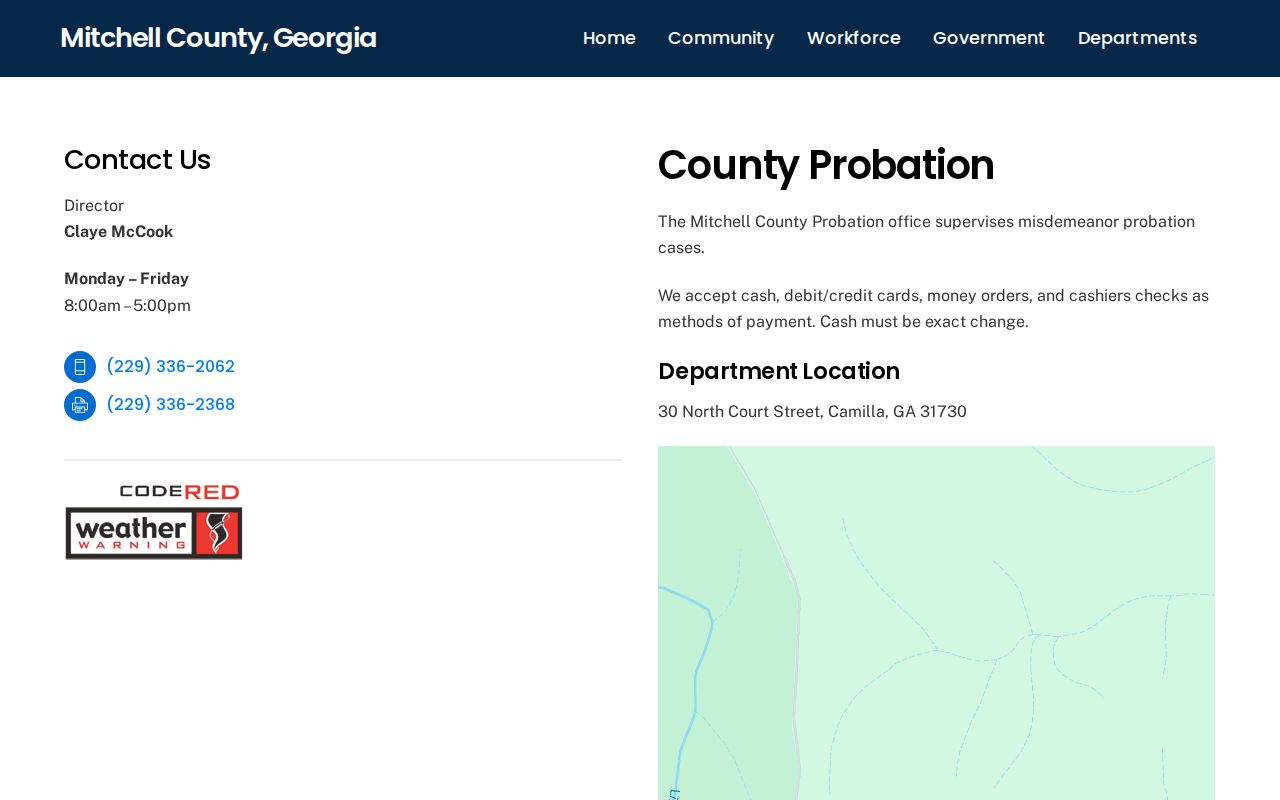
The county source confirms the office, director, phone, location, and stated misdemeanor function used in this routing.
Mitchell Parole Reentry Programs
The Mitchell County Correctional Institute provides a local reentry context that does not exist in every county. Its county description says the facility houses state inmates and a small group of county offenders. It also lists academic, counseling, and religious activities and states a goal of enhancing offender reentry through evidence-based programming. These facts explain why a state inmate held there may have program or work information relevant to a parole review.
Program participation does not guarantee parole or a particular date. The Board keeps decision authority, and DCS handles field supervision after an eligible release. The inmate's GDC record, any Tentative Parole Month, the Board decision, and the assigned supervision office are the sources for an individual case. County program descriptions supply context only.
The Mitchell County Correctional Institute description also documents county work details. Those facts may relate to Performance Incentive Credit for eligible state inmates, but only GDC and the Board can confirm whether credit was earned or used.
Note: A county offender at the same institution can follow county sentence rules instead of the GDC parole process.
Mitchell Parole Decisions and Meetings
Georgia does not treat routine parole consideration as a Mitchell County courtroom hearing. The Board evaluates state cases through its own process. Most parole-eligible inmates are eligible for consideration after one-third of the prison sentence, according to the Georgia parole process, but offense, crime date, recidivist status, life-sentence rules, and statutory exclusions can change eligibility. Serious violent felony and non-parole-eligible categories defeat any simple statewide percentage claim.
The Board's public agency meetings are a different matter. Scheduling, agendas, changes, and cancellations are published through Parole Board press releases. Those monthly operational meetings are not a public docket of individual Mitchell County parole decisions. A specific prisoner's Tentative Parole Month, called a TPM, comes from the Board lookup, while a released parolee is checked in the parolee search.
See the official parole-process source reflected in the captured page.
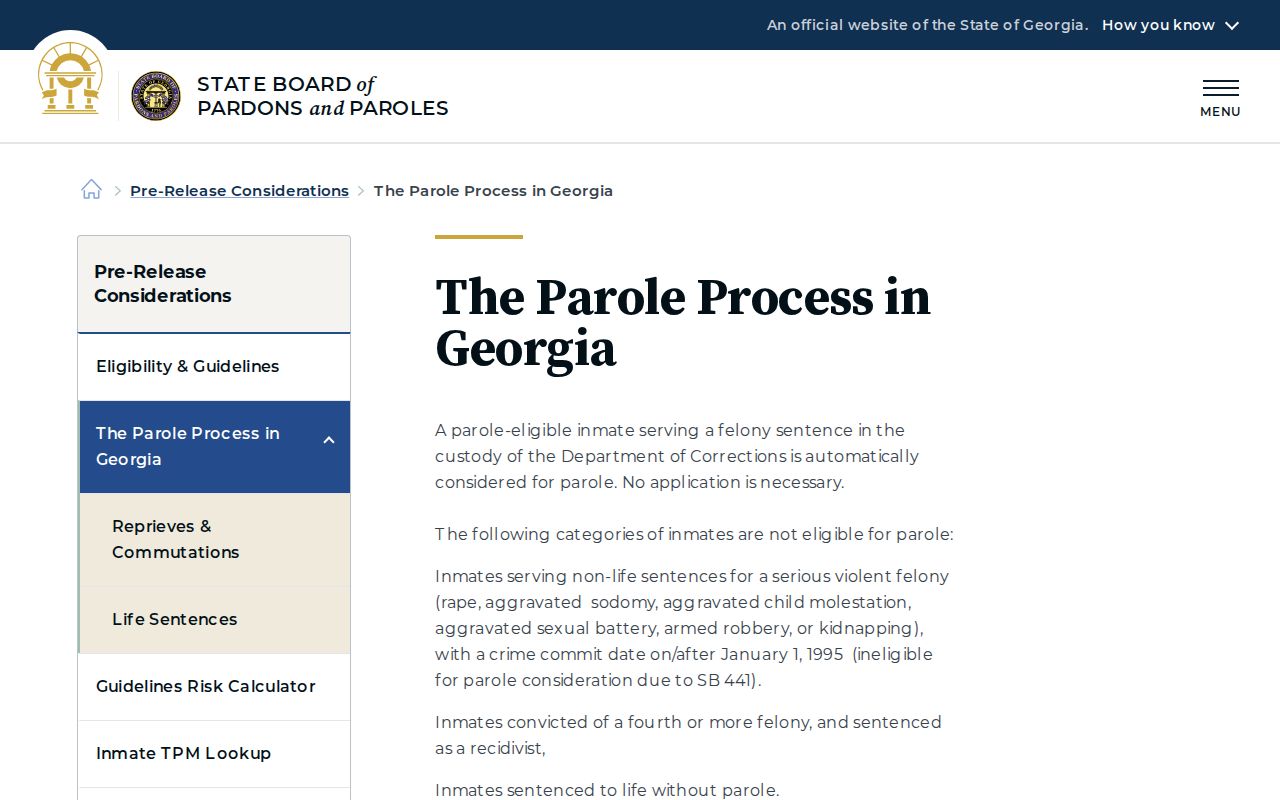
The Board source supports the eligibility limits and process distinctions that apply to state inmates at Autry and the correctional institution.
Mitchell Supervision Warrant Checks
An absconder label or warrant can signal a claimed violation, missed reporting, or unknown location. It is not a release-feed field. For a parole or felony supervision issue, compare the parolee record, ask DCS, and check the court or issuing authority. Do not assume a person is wanted from an old or incomplete result. Current confirmation matters.
Mitchell County gives two official contact presentations. The county sheriff department page lists Civil and Warrant Service at (229) 336-2033. The Sheriff's Office contact page routes warrants and civil questions through the main number, (229) 336-2030. Because those official pages differ, callers can start with the main line and ask for the warrant or civil unit. DCS remains the right source for a state supervision status.
A warrant may also arise from a court case unrelated to the release event. The warrant authority, supervision agency, and court record each answer a different question. No one source should be stretched beyond its role.
Correct Mitchell Supervision Records
A release entry and a supervision record can disagree because they record different events. The sheriff record may show departure from the Justice Center, while a Board or DCS record shows the next legal status. If the county release entry is unclear, the Sheriff's T.A.C. and Open Records contact identifies Deborah Holton at (229) 336-2030 and mitchellsotac@mitchellso.com. A focused request should give the full name, known date of birth, booking date, and case number when available.
Ask for the existing booking or release entry. The request should seek the release date and time if recorded, release reason, bond or court notation, and transfer or detainer destination. It should not ask the sheriff to decide whether parole or probation is active. That question belongs to the Board, DCS, Mitchell County Probation, or the sentencing court, depending on the case.
Georgia open-records rules allow redaction and some delay or withholding for exempt material. A specific request reduces mismatches. If an agency record is wrong, ask that agency for its correction process and provide the source record that supports the change.
Mitchell Supervision Discharge Records
Supervision ends through formal discharge, sentence completion, a court order, or another lawful agency action. A parole end date is useful, but it should be confirmed when the exact legal end matters. The parolee search may show begin and end dates. DCS or the Board can address state supervision records, while Mitchell County Probation and the sentencing court handle local misdemeanor records.
Release and discharge are not synonyms. Release means leaving a stated custody status. Discharge means the sentence or supervision obligation has ended. A person can be released from Autry onto parole and remain under supervision for years, or leave the Justice Center on bond with a court case still open. The final court or agency record resolves the status.