
Two Institution Release Paths
Mitchell County Correctional Institution is a county correctional institution with a mixed population. The county describes 149 beds for 140 state inmates and nine county offenders. That distinction controls release verification. A state inmate remains within GDC authority and may be discharged, paroled, or transferred. A county offender follows the local sentence, institution record, and sentencing court.
Ask one question first: state inmate or county offender? For a state inmate, use GDC Find an Offender, then parole and DCS tools if applicable. For a county offender, contact the institution and inspect the court judgment. A transfer out is not always community release.
Confirm Institution Release Status
Begin with the person's GDC ID, case number, full name, and birth date. A state record can display current location, status, sentence information, maximum release date, and parole eligibility fields. GDC warns that information can change and should be verified with Inmate Records and Information when a formal record is needed.
- Determine the legal custodian from the commitment or facility record.
- Search GDC if the person is a state inmate.
- Read released, discharged, transferred, or current custody in context.
- Check the parolee search for release onto parole and DCS for supervision.
- For a county offender, request the institution release record and sentencing court file.
The Mitchell County release search separates county jail, county sentence, and state-prison paths. Do not use the Justice Center recent-release process as proof of a GDC discharge merely because the two facilities are nearby.
Institution Records and Contact
The county page identifies Warden Cedric Taylor and counselor Shaundrika Taylor. The facility can clarify whether the person was held as a state inmate or county offender and which custodian owns the requested record.
Mitchell County Correctional Institution4838 Highway 37 East
Camilla, GA 31730
Phone: (229) 336-2045
Fax: (229) 336-2047
Counselor email: staylor@mitchellcountyga.net
For state records, GDC lists Inmate Records and Information, P.O. Box 1529, Forsyth, GA 31029. For a local sentence, ask for the existing commitment, release entry, date, reason, and destination. Court staff provide the judgment but do not calculate a GDC release.
Mitchell Institution Custody Type
This facility is not simply a county jail and is not identical to Autry State Prison. Mitchell County operates it under GDC standards and contract arrangements for state inmates. It houses adult male felons at medium and minimum security. The county states a capacity of 149 and gives the mixed allocation noted above.
Population counts are facility descriptions, not proof of an individual's status. Confirm the person's custody class in an official record before choosing a release path.
Mitchell Institution History
The county says the correctional institution was constructed in 1951 and opened in 1953. That history distinguishes it from Autry, the later GDC state prison in Pelham. The county institution page preserves its local mission and mixed-custody description.
The successful source capture below shows the county facility information used for the capacity, address, program, and operational facts.
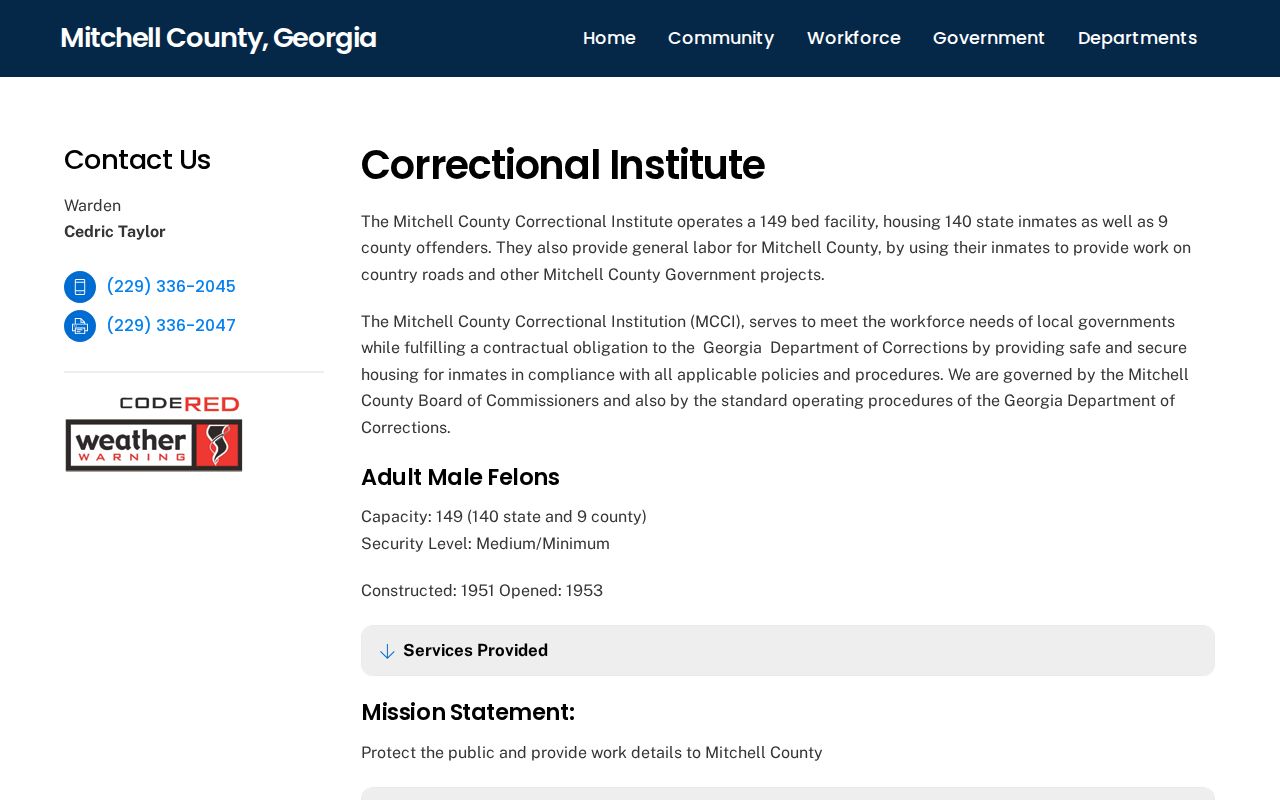
Its age does not change which agency controls a particular release. Legal custody remains the key.
Institution Work and Reentry Programs
The institution supplies labor for county roads and projects, supports county departments, provides contract details to Camilla and Pelham, maintains dumpsters, handles roadside tree removal, and maintains a county inmate fire team. The county also lists academic, counseling, religious, and other evidence-based programming aimed at reentry.
Programs and work details provide facility context. They do not prove that one inmate earned release credit, completed a case plan, or received parole. GDC's Performance Incentive Credit program can affect an eligible state offender's tentative parole month or maximum release date, but only GDC and the parole board can confirm a person's calculation.
Institution Dates Can Change
A state inmate may have a maximum release date and, if parole eligible, a tentative parole month. Neither should be treated as a pickup appointment. Court amendments, jail credit, disciplinary reports, PIC decisions, detainers, residence-plan review, and parole action can move the practical date. A county offender instead may receive earned time under O.C.G.A. § 42-4-7, subject to lawful limits and behavior.
If GDC shows transfer, locate the receiving facility. If it shows release to parole, use the parolee search and DCS. If a county record shows release to another authority, follow that destination. The word released describes departure from one custodian and may not mean the person entered the community.
Institution Release Record Fields
Request the committed name, GDC ID or county identifier, commitment date, sentencing authority, sentence reference, release or transfer date, release type, and destination. For a state inmate, compare maximum release date, parole information, and GDC facility history. For a county offender, compare the county record with the judgment.
Maximum release date is not always community entry. Parole eligibility is not a grant. Transfer is not discharge. A release entry may reflect a detainer handoff. Strong confirmation combines the event, legal custodian, and destination.
If the institution does not own a state record, contact GDC Inmate Records. If GDC identifies a county offender outside its calculation, return to the institution and court.
Institution Court and Parole Checks
The court file can show the sentence, amended judgment, time-served credit, or county release order. It does not replace GDC computation. A projected GDC date does not change the court sentence.
For parole-eligible state inmates, the TPM lookup supplies tentative timing and the parolee search identifies release to parole. DCS manages state supervision. A county offender may instead have a local probation order.
Institution Transfer Destinations
A state inmate can leave Mitchell County Correctional Institution for another GDC prison, parole, discharge, a hospital or special unit, or another authority. GDC facility history and the release or transfer entry should identify the next step. When the receiving location is another GDC facility, continue in the same offender record. When another government receives custody, use that agency's locator or records office.
A county offender may return to the community after lawful county sentence completion, enter probation under a court order, move to the Justice Center, or transfer under a detainer. The institution and sentencing court are the correct local sources. Do not infer the destination simply because the person no longer appears at the facility.
The practical fallback is a purpose-neutral records request. Provide identifiers and request the existing departure entry, date, reason, and destination. If part of a pending case is withheld, ask for any nonexempt fields and an explanation of the cited exemption. Georgia law generally favors redaction of protected details rather than withholding an entire public record when releasable portions remain.
Institution Record Corrections
If the public GDC result conflicts with a county record, first confirm that both refer to the same person and custody class. Then contact the custodian of the disputed field. GDC corrects its offender record; the institution handles its local entry; the clerk handles the judgment. Send the source document that supports the correction and keep the response.
A missing online result does not prove that no record exists. Name variants, identifier errors, transfers, and update timing can affect a search. Use the GDC ID for state custody and a local identifier for a county sentence whenever possible.